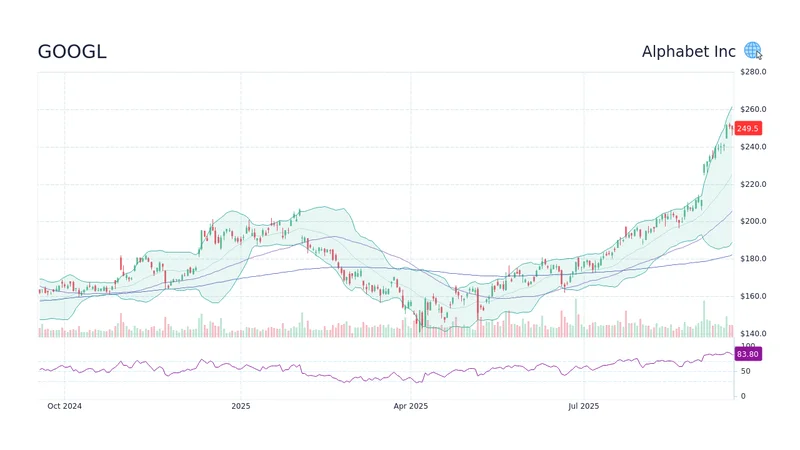
Let’s cut straight to the numbers, because that’s where the real story lives. On Friday, Berkshire Hathaway dropped a regulatory filing with the SEC, revealing a fresh $4.3 billion stake in Alphabet (GOOGL), Google’s parent company. Berkshire Hathaway Reveals $4.3 Billion Stake in Alphabet Stock (GOOGL) - TipRanks As of September 30, Berkshire was sitting on 17.85 million Alphabet shares, making it their tenth-largest U.S. stock holding. The immediate market reaction was predictable: Alphabet shares, which had dipped earlier that day after the company firmly rejected the EU’s demand for an AdTech business breakup (instead offering what I can only describe as "tweaks") Alphabet Rejects EU’s AdTech Breakup, Offers Changes; GOOGL Stock Falls - TipRanks, promptly climbed 1.7% in after-hours trading. The market, it seems, still takes "Buffett’s seal of approval" as gospel.
But anyone who’s been watching the Oracle of Omaha for more than a minute knows this isn’t business as usual. This isn’t Coca-Cola or American Express. This is tech. And not just any tech, but one of the biggest, most visible tech giants, a company whose entire existence is predicated on digital advertising and data, concepts that once felt anathema to Buffett’s traditional value investing philosophy. My analysis suggests this isn't just another casual buy. It's a fascinating, almost contradictory, move that begs a deeper look than the usual headlines afford.
For decades, Warren Buffett famously kept his distance from the tech sector, often citing his lack of understanding of the underlying businesses. This wasn't some arbitrary preference; it was a core tenet of his investment philosophy: only invest in what you truly comprehend. So, what changed? Well, in 2019, Buffett and Charlie Munger, at Berkshire's annual shareholder meeting, admitted a significant regret: not investing in Google sooner. They saw similarities between Google's advertising model and Berkshire’s own Geico car insurance unit, a business built on massive, repeatable ad spend to acquire customers. That’s a crucial data point, because it signals a cognitive shift that began years ago, a quiet recognition that perhaps the "tech" label was obscuring a fundamentally sound, understandable business model.
This isn't a sudden epiphany, then, but a delayed execution on a previously acknowledged oversight. The timing of this particular purchase is also worth dissecting. It lands amidst a period where Berkshire has been a significant net seller of stocks for twelve consecutive quarters, leading to a staggering $381.7 billion in cash reserves. They bought $6.4 billion in stocks between July and September, but sold $12.5 billion. To put it another way, for every dollar they put into the market, they pulled out nearly two. This isn't the behavior of a buyer-at-all-costs. This is the behavior of a highly selective investor, sitting on a mountain of cash, waiting for precisely the right pitch. And that pitch, apparently, was Alphabet, particularly after its shares took a hit following the EU news. Is it a strategic shift in philosophy, or simply a pragmatic deployment of capital into an asset they now understand better, bought at a moment of perceived weakness? I’m leaning towards the latter, with a healthy dose of the former baked in.
Let’s not forget the other significant portfolio adjustments. Berkshire also pared down its Apple stake, reducing it from 280 million shares to 238.2 million in the third quarter. While Apple (AAPL) remains Berkshire's largest holding by a mile—a cool $60.7 billion—this reduction, following the sale of nearly three-quarters of their original 900+ million shares, tells a story. It suggests a rebalancing, perhaps a reallocation of tech exposure rather than a wholesale embrace of it. They also shed their stake in DR Horton, sold 6% of Bank of America (still their third-largest holding), and bought more Chubb and Domino’s Pizza. This isn't a tech-first strategy; it’s a highly diversified, opportunistic approach.
What does this tell us about the future? It’s unclear whether Buffett himself, or portfolio managers Todd Combs and Ted Weschler, or even CEO-designate Greg Abel, made the specific Alphabet purchase. Given the size, Buffett typically handles these larger investments. But this filing is the last detailing Berkshire's equity portfolio before Buffett ends his 60-year run as CEO on January 1. This new GOOGL stake, therefore, feels like a final, deliberate statement from the maestro, a kind of passing of the torch or a confirmation of a refined strategy before he steps back. It’s a subtle nod to the enduring power of platforms and advertising, even as the landscape shifts around them.
I've reviewed countless 13F filings over the years, and this one, particularly given the historical context, genuinely piqued my interest. The market often acts like a herd, rushing to emulate "Buffett’s seal of approval," but the real question isn't whether the stock will go up—it usually does, at least initially—but why it was bought, and what that signals about Berkshire's long-term view. Is it a recognition that the "moat" around companies like Alphabet is now undeniable, even for the most traditional of investors? Or is it simply a smart play on a dip in a fundamentally strong company that was previously overlooked due to a philosophical hang-up? My money's on a blend, a calculated contradiction that leverages both past insights and present opportunities.